How should a company or a project be rethought today? As a network of intelligence, part digital intelligence and part biological intelligence.
Digital intelligence is characterized by an extremely high speed of uploading and downloading information, and by the ability to create correlations while keeping active all the information it has received.
Biological intelligence has a problem of upload and download speed, because it is extremely slow. However, it is a server that has accumulated a great ability for intuition and a great ability to determine the relative importance of data. In this way, it is able to build nonlinear processes that think outside of preestablished patterns.
Because of the introduction of AI, this translates into an exponential shift.
This short article is based on the research we have done over the past months on the change in consumer behaviour, and on how this change is modifying some fundamental pillars of our society that have shaped economic strategies. Not only do these pillars no longer hold value, but their foundations are eroding. And yet this is not visible yet. So this is meant to be a short guide to the four pillars that have broken, and to the attitude a strategy today has to take into account.
You are not talking to a human.
Some of the oldest assumptions, that there is a human on the other side, are breaking, and with that the structure marketing has stood on for decades.
01The four pillars
For a long time, marketing rested on four pillars.
- There is a human on the other side.
- Exposure equals attention.
- Behaviour equals intent.
- Persuasion equals conversion.
Every channel we built leaned on those four, from banners to search to social feeds.
If a person saw your message, you had their attention.
If they clicked, they wanted something.
If you persuaded them well, you had a conversion.
In 2026, all four broke at the same time. I want to walk through each one with the evidence, and with the caveats kept, because the caveats are part of the honesty this subject requires.
02Pillar one: the audience is no longer mostly human
On 3 June 2026, Cloudflare’s CEO Matthew Prince said bots had passed human traffic online “for the first time in the Internet’s history.” Cloudflare’s data at the time showed a split of 57.5% bot to 42.5% human HTTP requests. Cloudflare attributes much of the growth to AI agents that read product pages, check prices, compare options and complete multi-step tasks on behalf of people.
Humans still dominate the time spent in apps and feeds (for now). And Cloudflare’s own CEO described the data around the crossover point as “a bit messy.” But the writing is on the wall.
The direction is clear. The precise date is not. But it’s soon.
A different data set points the same way. Imperva’s 2025 Bad Bot Report found that automated traffic was 51% of all web traffic, and that bad bots alone accounted for 37%.
I see the consequence from inside an operating business. At Monarchy, our internal call center generates nearly 8,000 appointments a month, and our systems handle millions of interactions. What we observe is that the metrics that used to be reliable byproducts of revenue, views and impressions and surface engagement, progressively fail to represent actual conversion.
The reason is not only that an AI may now sit on the other side of the screen. It is deeper. The mechanism people use to form a preference and make a choice has changed. When that mechanism changes, measuring the old signals harder does not help. You have to rethink the structure itself.
03Pillar two: the click is disappearing
The second pillar said that exposure meant attention, and that attention would turn into a visit. Search was the cleanest proof of it. Someone typed a need, you appeared, they clicked.
SparkToro and Similarweb found that 68.01% of US Google searches in January to April 2026 ended without a click, up from 60.45% in 2024, and from about 45% roughly a decade ago. The panels differ by year, as SparkToro itself cautions, so I read the trend rather than the decimal.
The same study notes that AI Overviews now appear on more than 20% of searches and, when present, reduce click-through rate by nearly 60%. Gartner predicted in February 2024 that traditional search engine volume would drop 25% by 2026 as AI chatbots and virtual agents substitute for queries. That is a forecast, not a measurement, but it points in the same direction.
The buyer still has intent, for now. The answer simply arrives before anyone reaches a website.
This is the part I find philosophically interesting. Intent has not disappeared. Desire, curiosity and need are as human as ever. What has changed is where that intent gets resolved or created. It used to be resolved on your property, under your lighting, in your words. Now it is resolved upstream, in a summary you did not write, by a system that read you on behalf of someone else. Behaviour you can observe no longer tells you much about the intent behind it, which is exactly why the third pillar goes with the second.
AI’s suggestions are becoming the basis for the creation of preference and intent on the part of humans.
04Pillar three: production became a commodity
Making things got apparently cheap. Stanford’s AI Index 2025 reports that inference costs at the GPT-3.5 level fell more than 280-fold in two years. In McKinsey’s 2026 survey, 32% of organizations already build software in-house with agentic tools instead of buying it.
But cheap production is not the real problem. It is the symptom.
05Pillar four: persuasion stopped being a strategy
The real problem is that technology is moving faster than people can adapt. That gap produces two effects, and both of them erode the idea that persuading people well (through a mix of image, presence and copy) is enough.
The first is that organizations increasingly assume they no longer need lived experience to make decisions. When customer understanding is built by asking an AI instead of speaking with real people, a company gets the illusion of market knowledge while drifting away from ground truth.
There is an old lesson here. Edward Lorenz’s classic weather experiment at MIT showed how two runs that started from the same data diverged when nobody checked them against real observations. Later research in Nature described the same mechanism in AI. Models fed synthetic outputs without fresh human data suffer what is called model collapse. A company that only consults machines about its customers is running that experiment on itself.
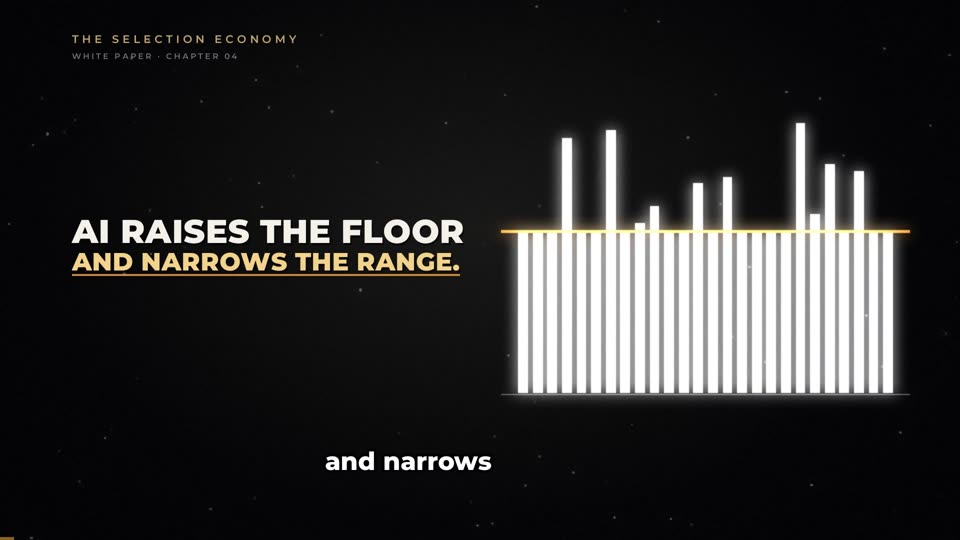
The second effect is that real competence is disappearing. Because anyone can now generate anything, weak operators get a short-term floor, while the whole industry converges on the same level. Every ad looks the same. Every website reads the same. More communication goes out faster, and each piece means less.
When everything is persuasive in the same way, persuasion stops being a differentiator. It becomes background noise, and noise is precisely what an agent is designed to filter out.
Understanding how to position real human communication and verification inside the AI ecosystem will be the dividing line between businesses that remain Blockbusters in a Netflix world and businesses capable of evolving.
06Why the revenue lines have not shown it yet
If attention is eroding, why is the largest attention business in the world still growing? It is a fair question, and the most common objection I hear.
Alphabet reported Google advertising revenue of $294.7 billion for 2025, up from $264.6 billion in 2024, with Google Search & other at $224.5 billion. SparkToro’s own reading is that Google’s zero-click changes have so far boosted ad revenue and investor confidence.
That is not a contradiction.
A platform can capture more value while the businesses that pay it receive less traffic in return.
The useful question for anyone running or investing in those businesses is not whether the platform is healthy. It is whether customer acquisition still works when the buyer’s agent does the shortlisting.
There is always a delay between the erosion of a foundation and the perception of it. Buildings do not fall the day the water gets into the concrete. The numbers have not caught up yet. They will.
07What it means
An impression may not be attention. A visit may not be a visitor. Before you optimize any metric, ask how much of it reflects a person and how much reflects a machine reading on a person’s behalf.
Then accept that you now have two audiences. One is human and decides. The other is an agent and shortlists. The agent needs clear, verifiable, structured truth about what you sell and what it costs.
The human needs a reason to trust you once the shortlist arrives. Generic content serves neither of them well, because the agent cannot tell it apart from your competitors and the human has already seen a hundred versions of it.
08What it means for funds and investors
If you invest, the interesting diligence question is whether the business acquisition model is ready for the new era and still works when traffic stops being the unit of exchange. Understanding how preference (not persuasion) is created and having a clear strategy for it is probably the missing piece of every brand we touch, from dental offices and Dental Service Organizations, to Medical Service Organizations, fertility clinics and tech startups.
09What will stand
I keep coming back to a simple picture. For most of history, the question “who am I talking to?” had an obvious answer. Now it has to be asked again. Because most likely, you’re not talking to a human.
A few questions we constantly experiment and research on for our clients are:
- What’s the value of attention now for this “brand”?
- Does attention still cause growth and conversion?
- How is this brand creating preference and differentiation outside of the branding and persuasion route?
- If you have an audience that is banner and advertising blind, how would they choose?
If these questions are on your desk too, read the “You’re not talking to a human” article series or download our white paper.
Get our agent templates and get ready
Download our agent templates, we made them for you.
Questions this article answers
Should Ask Questions
SAQ: the questions you should be asking (and nobody is)
- How much of your traffic reflects a person, and how much a machine reading on a person’s behalf?
- Is your content built for both audiences: the agent that shortlists and the human who decides?
- Does your acquisition model still work when traffic stops being the unit of exchange?
- How is your brand creating preference outside of the branding and persuasion route?
Download the PDF. Give it to your agent.
Have your agent study our white papers alongside you.
Free download
Want the full version?
Leave your email and we’ll send it.
Thanks, you’re on the list.
We’ll send it to .
Sources
- Monarchy, “Four things broke at once” (original article). https://www.monarchy.io/resources/four-things-broke-at-once
- Cloudflare Radar, bot vs human traffic. https://radar.cloudflare.com/traffic#bot-vs-human
- Tom’s Hardware, Cloudflare CEO on bots passing human traffic (June 2026). https://www.tomshardware.com/tech-industry/artificial-intelligence/bots-have-now-passed-human-traffic-online-cloudflare-boss-laments-says-agentic-traffic-wasnt-expected-to-eclipse-real-people-until-next-year
- Imperva, 2025 Bad Bot Report. https://www.imperva.com/resources/resource-library/reports/2025-bad-bot-report/
- SparkToro & Similarweb, zero-click search study 2026. https://sparktoro.com/blog/in-2026-less-than-one-third-of-google-searches-still-send-a-click/
- Gartner, search volume prediction (19 Feb 2024). https://www.gartner.com/en/newsroom/press-releases/2024-02-19-gartner-predicts-search-engine-volume-will-drop-25-percent-by-2026-due-to-ai-chatbots-and-other-virtual-agents
- Stanford HAI, AI Index 2025. https://hai.stanford.edu/ai-index/2025-ai-index-report
- McKinsey, The State of AI. https://www.mckinsey.com/capabilities/quantumblack/our-insights/the-state-of-ai
- Lorenz (1963), Deterministic Nonperiodic Flow. https://doi.org/10.1175/1520-0469(1963)020
- Nature, model collapse. https://www.nature.com/articles/s41586-024-07566-y
- Alphabet FY2025 results (Q4 2025 exhibit 99.1). https://www.sec.gov/Archives/edgar/data/1652044/000165204426000012/googexhibit991q42025.htm
- Alphabet 2025 Form 10-K, revenue detail. https://www.sec.gov/Archives/edgar/data/1652044/000165204426000018/R12.htm